If you set your goals ridiculously high and it's a failure, you will fail above everyone else's success.

March 7, 2023 | Feast of St. Thomas Aquinas
You may say I'm a dreamer, but I'm not the only one. I hope someday you'll join us. And the world will live as one.
—John Lennon
Darkness cannot drive out darkness: only light can do that. Hate cannot drive out hate: only love can do that.
—Martin Luther King Jr.
Do not go where the path may lead, go instead where there is no path and leave a trail.
—Ralph Waldo Emerson
If you set your goals ridiculously high and it's a failure, you will fail above everyone else's success.
—James Cameron
You may say I'm a dreamer, but I'm not the only one. I hope someday you'll join us. And the world will live as one.
—John Lennon
Darkness cannot drive out darkness: only light can do that. Hate cannot drive out hate: only love can do that.
—Martin Luther King Jr.
Do not go where the path may lead, go instead where there is no path and leave a trail.
—Ralph Waldo Emerson
March 7, 2023 | Feast of St. Thomas Aquinas

Distributist Perspectives II

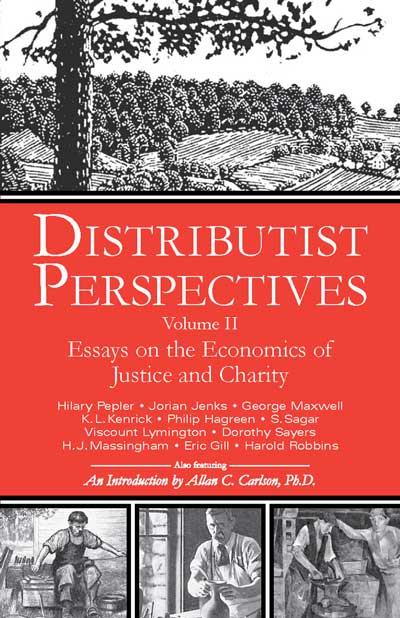
Distributist Perspectives II
Essays on the Economics of Justice and Charity
Author(s)
- Edited by John Sharpe, and D. L. O'Huallachain
- Introduction by Allen Carlson Ph.D.
Series
- Series : Distributist Perspectives
- Full Series
Following upon the successful first volume of the Distributist Perspectivesseries, this second volume compiles almost a dozen essays by English Distributist authors. Some are some well-known to the public – like Eric Gill and Dorothy Sayers – and others less so, yet all bring important insights to the manifest problems of our society. Although most of the contributions were written five decades and more ago, it remains that the questions addressed by the writers have largely remained without any serious or permanent solution. Questions concerning the nature and end of education whether or not the press is free, the satisfactory (or otherwise) nature of work, along with the question of smaller communities, family farms, and a just balance between the spiritual and material needs human person. This anthology presents to a new generation answers that were formulated by one of the most thoughtful and original groups of thinkers in English Catholic history – answers that have been largely forgotten or ignored since WWII, but which have lost none of their timeliness or relevance.
Introduction —Dr. Allan Carlson
Education for what? —Eric Gill
How Free is the Press? —Dorothy Sayers
Nature, the Family and the Nation —Viscount Lymington
Cottagers —H.J. Massingham
The Agricultural Village —Harold Robbins
Man’s Conquest of Nature —K.L. Kenrick
The Clergy and the Carpenter —Philip Hagreen
A Ballade of Inevitable Mechanization —Harold Robbins
What of the Dustman? —George Maxwell
Distributism —S. Sagar
Talking of Food —Jorian Jenks
Common Land —H.D.C. Pepler
- editors’ annotations
- contributor biographical sketches
No reviews available
Write a review